

21%of reported lease rates exceeded $1,500 per acrePurdue farmer survey, March 2026
Solar land lease rates
Solar Land Lease Rates: Published Payments and 2026 Offer Data
What solar developers are offering to lease land, how the payments are structured, and what they can add up to over a lease that often runs 25 to 30 years before renewals. Every figure names its source, and estimates, reported offers, and survey answers are kept apart.
2%–3%most common escalator range; 56% reported an escalator in the offerPurdue farmer survey, March 2026
25–30 yearstypical solar lease length, with renewalsUW–Madison Extension
Key findings
How much do solar companies pay per acre?
There is no authoritative national solar lease rate. These are the most useful public references: two university extension programs and a March 2026 national survey of farmers.
per acre per year in Wisconsin once construction is complete
UW–Madison Extension, 2024typical Pennsylvania offers per acre per year in October 2021
Penn State Extensionof reported lease rates were above $1,500 per acre
Purdue farmer survey, March 2026said offers included an escalator, most often 2%–3% a year
Purdue farmer survey, March 2026Published solar lease rates and offer evidence
| Source | Geography | Evidence type | Reported range or finding | Observed |
|---|---|---|---|---|
| UW–Madison Extension | Wisconsin | Published regional estimate | $500–$1,500 per acre per yearRate once construction is complete; UW notes lower rates during siting and construction. | 2024 guide |
| Penn State Extension | Pennsylvania | Reported offers | Typically $1,000–$1,200 per acre per year; broader range $800–$2,000Varies with proximity to electrical infrastructure, contracted power sales, and project size. | October 2021 offers |
| Purdue University / CME Group | United States | Farmer survey responses | About 21% of reported lease rates were above $1,500 per acreResponses about offers, not verified transactions or a representative national average. | 400 farmers, March 16–20, 2026 |
Read these as context, not prices
- Each row measures something different: an estimate, observed offers, or survey answers.
- None is a dataset of executed leases, and no public national one exists.
- The rows differ in place and date, so they are never averaged into one number.
- A specific offer depends on the parcel, the grid connection, and the project.
March 2026 Purdue farmer survey
What 400 farmers reported about solar offers
The Purdue University/CME Group Ag Economy Barometer periodically asks producers about solar leasing. Its March 16–20, 2026 survey [Purdue University / CME Group Ag Economy Barometer] found that lease rates varied considerably. Among offers that included an escalator, the most commonly reported range was 2% to 3% per year [Purdue University / CME Group Ag Economy Barometer].
These are survey responses about offers, not verified completed transactions or a representative national rent average.
- 12%
- discussed leasing farmland they own for solar in the previous six months
- 21%
- of reported lease rates were above $1,500 per acre
- 56%
- reported that contract offers included an escalator clause
- 5%
- said they or one of their landowners had signed a solar lease
Illustrative solar lease scenario
What could a 160-acre solar lease pay over 30 years?
Calculated with the LandLeaseRates solar lease calculator. These are example terms, not a market quote.
- Leased acreage
- 160 acres
- Starting annual rent
- $1,200/acre
- Operating term
- 30 years
- Annual escalator
- 2%
- First-year operating rent
- $192,000
- 30-year nominal operating total
- $7.79M
Assumes 30 full years of operating payments under the stated terms. Excludes option payments, taxes, expenses, and inflation adjustments. This is not a guaranteed return.
- 2% annual escalator
- No escalator
Source: LandLeaseRates solar lease calculator; illustrative terms
With a 2% escalator, year-30 rent reaches $340,962, and the 30-year total is $2.03M more than the same lease with flat rent of $192,000 a year.
Payment structure
How solar lease payments work
Most solar leases pay in phases. UW–Madison Extension describes lower rates during siting, moderate rates during construction, and a higher rate once operational [University of Wisconsin–Madison Extension], and leases that generally last 25 to 30 years, with renewals [University of Wisconsin–Madison Extension]. Compare each phase on its own before comparing offers.
Option payment
- When
- While the developer studies interconnection, permits, and financing.
- How it is quoted
- Per acre or per property; paid upfront, quarterly, or annually.
- What to check
- Option length, paid extensions, and when unused acres are released.
Construction payment
- When
- From construction start until the project begins operating.
- How it is quoted
- A one-time amount or a construction-stage rate.
- What to check
- What triggers it, crop-loss and damage payments, drainage and soil protection.
Operating rent
- When
- From commercial operation for the base term.
- How it is quoted
- Annual rent per leased acre, usually with an escalator.
- What to check
- How paid acres are measured, the escalator, and the payment date.
Extension or renewal
- When
- After the base term, often at the developer’s option.
- How it is quoted
- Rent continues under the lease formula, sometimes re-escalated.
- What to check
- Who decides, how many renewals, and decommissioning security throughout.
Penn State Extension notes option payments may be per acre or per property, paid upfront, quarterly, or annually [Penn State Extension], and that escalators in the agreements it reviewed commonly ran 1% to 2.5% per year [Penn State Extension]. Some leases instead pay a percentage of the energy generated [U.S. Department of Energy].
Why paid acreage matters
200 acres under option is not 200 acres of rent
Developers often option more land than they build on, then pay operating rent only on the final leased premises. In the example above, the option covers 200 acres but operating rent is paid on 160. At $1,200 per leased acre, first-year rent is $192,000, which works out to $960 per controlled acre. A landowner who assumed every acre was paid would have expected $240,000.
Ask how the paid area will be surveyed, whether roads, fencing, substations, and cable easements are paid, and when unused acres are released back to you.
Why offers differ
What affects solar lease rates?
Penn State Extension attributes Pennsylvania’s range to proximity to existing electrical infrastructure, contracted downstream power sales, and size of the project [Penn State Extension]. Two nearby parcels can receive very different offers for these reasons.
Interconnection and grid upgrades
Available capacity at a nearby substation or line, the cost of upgrades the utility requires, and the project’s place in the interconnection queue.
Usable acreage
Large, contiguous, buildable acres after setbacks, wetlands, floodplain, and easements; a parcel’s gross size overstates it.
Site characteristics
Slope, drainage, soils, shading, road access, and the grading or environmental work a site would need.
Zoning and permitting
Local solar ordinances, setbacks, permitting timelines, community conditions, and tax treatment.
Power-market economics
The price the project can sell power for, who buys it, and how many developers are competing for sites nearby.
Solar leasing vs. traditional farmland rent
Penn State Extension says the solar lease price per acre is likely to be greater than what farmers could earn growing common crops [Penn State Extension]. The higher number buys a very different commitment, so USDA cash rents are a measure of what the land earns today, not comparables for a solar offer.
| Term | Farmland cash rent | Solar land lease |
|---|---|---|
| Length | Often one to a few years, renegotiated as markets change | Decades, plus developer renewal options |
| Land use | Stays in production; the land can return to you quickly | Converted to an energy facility unless shared use is written in |
| Payment certainty | Paid each season the land is farmed | Operating rent starts only if the project is built |
| How rent changes | Reset with crop prices and local demand | Fixed formula, usually a contractual escalator |
| End of term | Land returns as farmed | Depends on decommissioning and restoration terms |
See county figures in the 2026 farmland cash rent report to understand what the land earns in agriculture today.
Agrivoltaics
Can farming continue alongside solar panels?
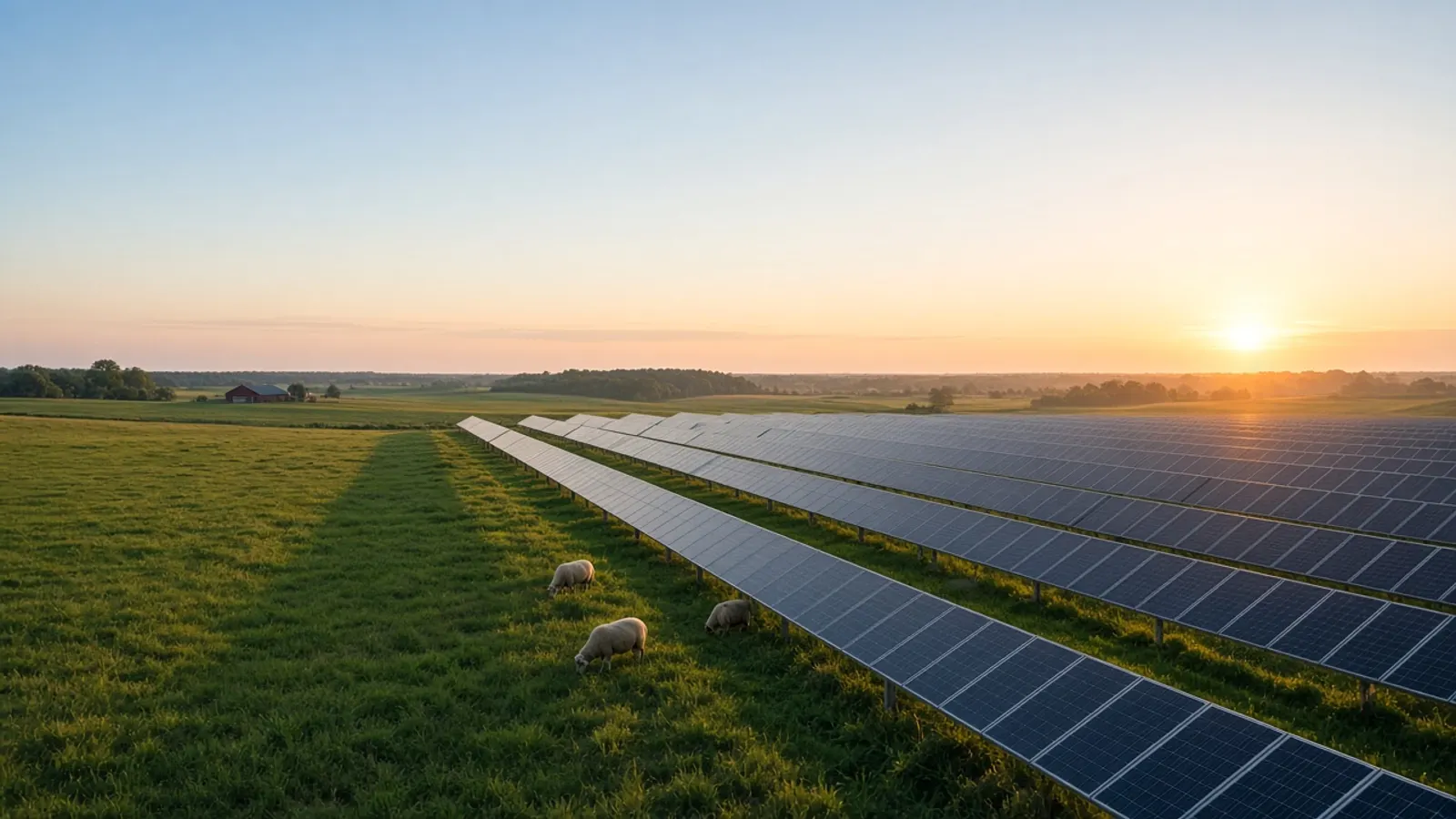
Sometimes, and only if the lease allows it. The U.S. Department of Energy defines agrivoltaics as crop production, livestock grazing, and pollinator habitat located underneath solar panels or between rows [U.S. Department of Energy].
- Grazing. Most standard utility-scale arrays can accommodate sheep, while cattle generally need elevated panels. DOE cites NREL data showing over 4,000 megawatts of U.S. solar with sheep grazing underneath [U.S. Department of Energy] as of November 2023.
- Crops. Raising panels or widening rows makes room for equipment and light, but DOE notes higher panels add steel cost and wider spacing produces less electricity per acre. That cost usually shows up in the developer’s economics and the offer.
- Who gets paid. Operators can save on mowing and herbicide, and DOE notes local shepherds may be paid to manage grazing. Settle in writing whether you, a tenant, or a contractor holds those rights.
Questions to settle in the lease
- Which agricultural uses are permitted, and on which acres?
- Who supplies fencing, water, and livestock insurance?
- Does shared use change the rent or the paid acreage?
- How is soil protected during construction and restored at the end?
Before you sign
How to evaluate a solar lease offer
A concise financial checklist. For contract provisions such as assignment, termination, insurance, and decommissioning security, use the solar land lease guide; to check whether a parcel fits what developers screen for, see lease land for a solar farm.
- Write out every payment phase separately: option, construction, operating, and renewal.
- Convert each recurring payment to an annual amount on the acres it actually covers.
- Model the escalator over the base term and every renewal, as written.
- Total the option period on its own; it does not guarantee operating rent.
- Compare the result with what the land earns in farming today.
- Get independent legal and tax review before granting site control.
Model your offer
Enter the terms as written. The calculator keeps option and operating payments separate and does not save your inputs.
Calculate your solar lease paymentsExplore solar development activity by county
Public records of planned and operating solar projects. Project records show development activity, not lease prices.
Open the development mapQuestions landowners ask
Frequently asked questions
Short answers drawn from the sources listed on this page.
How much do solar companies pay to lease land per acre?
There is no authoritative national rate. UW–Madison Extension reports Wisconsin rent in the $500–$1,500 per acre per year range once construction is complete. Penn State Extension reported Pennsylvania offers typically between $1,000 and $1,200 per acre per year in October 2021, with a broader $800–$2,000 range. In Purdue’s March 2026 survey of 400 farmers, about 21% of reported lease rates were above $1,500 per acre.
What is a typical solar lease escalator?
In Purdue’s March 2026 survey, 56% of respondents said offers included an escalator clause, most commonly 2% to 3% per year. Penn State Extension reports escalators in the agreements it reviewed commonly between 1% and 2.5% per year. Confirm whether the increase is annual or periodic and whether it continues into renewals.
How long does a solar land lease last?
UW–Madison Extension says solar leases generally last 25 to 30 years, with renewals for additional periods that are often at the developer’s option. An option period for studies and permitting usually comes first, so the total commitment can be longer than the operating term.
Do landowners get paid during the option period?
Usually, but at a lower level than operating rent. Penn State Extension notes option payments may be per acre or per property and paid upfront, quarterly, or annually. An option does not guarantee that the developer will build or that operating rent will begin.
Is the entire parcel paid at the operating rate?
Not necessarily. Agreements may option a larger control area but pay operating rent only on the final leased premises, easements, roads or other defined acreage. Ask how the paid acreage will be measured.
What determines a solar lease rate?
Distance to usable grid capacity and the cost of interconnection upgrades, contiguous usable acreage, site conditions, local zoning and permitting, the value of the power sale, project size, and the developer’s competition for sites all affect an offer.
Can I keep farming or grazing on land leased for solar?
Sometimes. The U.S. Department of Energy describes agrivoltaics as crop production, grazing, or pollinator habitat under or between panels. Most standard utility-scale arrays can accommodate sheep, while cattle generally need elevated, reinforced arrays. Any shared use has to be written into the lease.
Is solar lease income higher than farmland cash rent?
Per-acre solar rent is often higher than local cash rent, but the two are different contracts. A solar lease commits land for decades, limits other uses, and depends on project milestones, so USDA cash rents are context for opportunity cost rather than comparables for a solar offer.
Does signing a solar lease mean a project will be built?
No. Many projects never reach construction. In Purdue’s March 2026 survey, 12% of farmers had discussed a solar lease in the previous six months, while 5% said they or one of their landowners had signed one.
Related guides
Sources
- University of Wisconsin–Madison Extension: Solar Leasing GuidePublished 2024-08-19 · accessed 2026-10-08
- Penn State Extension: Localized Economic Impacts of Grid-Scale Solar DevelopmentPublished 2025-01-24 · accessed 2026-10-08
- Penn State Extension: Pennsylvania Landowners Guide to Utility-Scale Solar LeasingPublished 2025-01-24 · accessed 2026-10-04
- Purdue University / CME Group Ag Economy Barometer: Farmer Sentiment Improves Despite Rising Input Costs Concerns (March 2026 survey)Published 2026-04-07 · accessed 2026-10-08
- U.S. Department of Energy: Farmer's Guide to Going SolarUndated · accessed 2026-10-08